
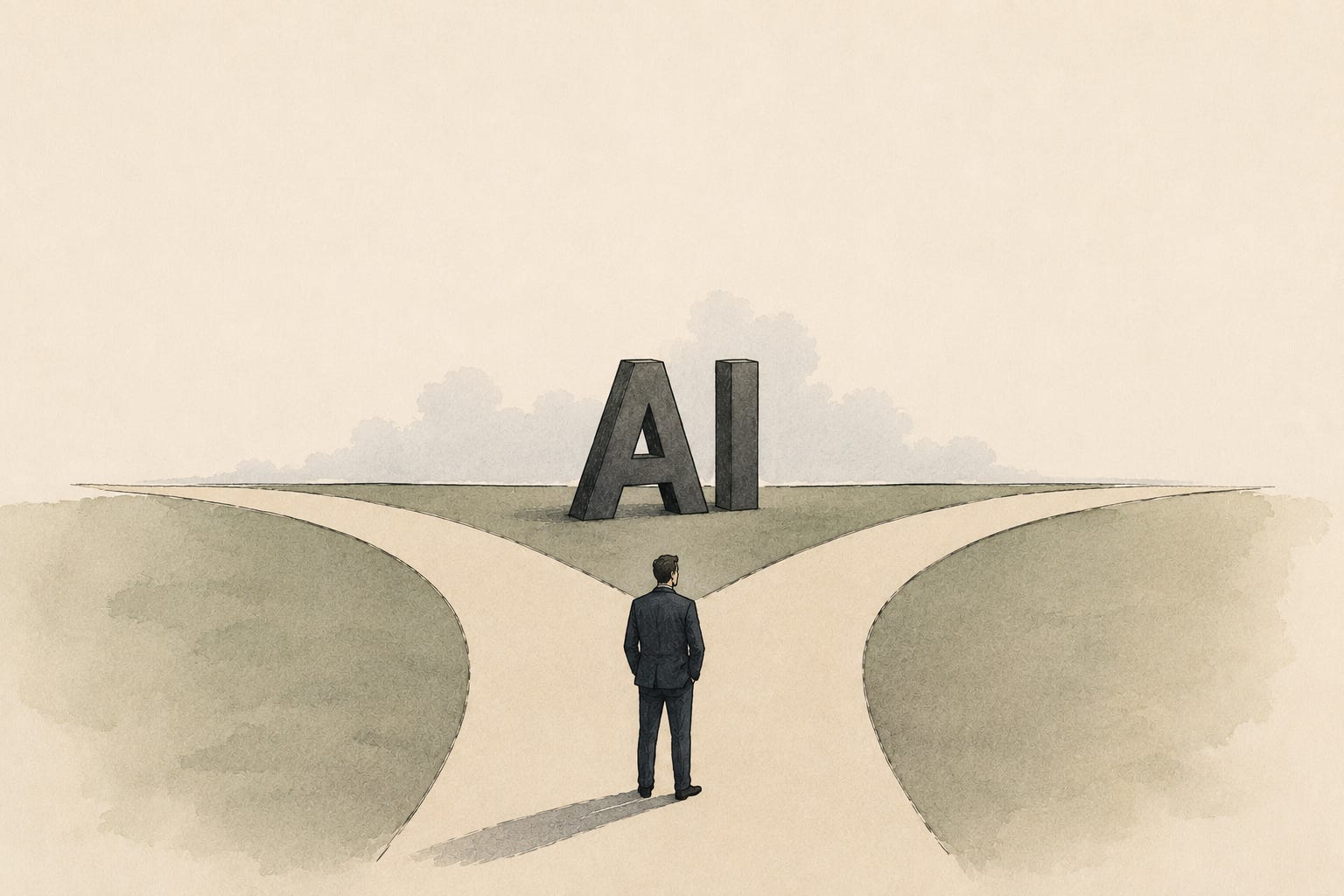
AI, at a Crossroads
Anthropic sees where things are headed. If only it was the only one driving.

Anthropic filed initial paperwork last week to become a publicly traded company. Its valuation is approaching $1 trillion, placing it among the most valuable enterprises in the history of commerce.
That number is worth sitting with for a moment. Anthropic was founded five years ago. It did not exist in 2020. It barely existed in 2021, when a group of executives walked away from OpenAI after concluding that Sam Altman’s commitment to AI safety was insufficient. Claude, Anthropic’s large language model, made its public debut in the spring of 2023. In the span of a single presidential term, a handful of engineers with a shared grievance and a shared principle built something approaching a trillion-dollar company.
That is not merely a technology story. It is a history story.
Three recent events have established just how much Anthropic now matters.
The first was its collision with the Pentagon. After months of negotiations with the Trump administration, Anthropic’s CEO Dario Amodei refused to grant the Defense Department unlimited rights to deploy Claude for autonomous warfare and mass domestic surveillance. This was no minor objection. Amodei’s position was that the company had been founded on an explicit commitment to ethical guardrails — guardrails that were not negotiable, whatever the price. The administration responded by labeling Anthropic a “supply chain risk,” a designation rarely invoked against American companies. Pentagon contractors were banned from using Claude.
Most observers assumed this would wound Anthropic. It may wound the Pentagon more. Claude is embedded not just in the workflows of major defense contractors but, reportedly, in the targeting systems deployed in the war against Iran and the capture of Nicolás Maduro. Palantir CEO Alex Karp confirmed in March that his company — one of the largest Pentagon contractors ever — would continue to use Claude regardless. The government that set out to punish Anthropic may have discovered it cannot afford to.
The second event occurred in Rome. In late May, Pope Leo XIV and the Vatican released “Magnifica Humanitas” — the first encyclical of the new papacy and a formal effort by the Catholic Church to set the moral terms by which humanity ought to engage with AI. That day, Anthropic co-founder Christopher Olah spoke from the same dais as the pope. A founder of a 5-year-old company sharing the stage with the head of a 2,000-year-old institution representing more than one billion people — that is either an extraordinary moment in the history of technology or an extraordinary moment in the history of the Church. Actually, it may well be both.
The third event was a warning from Anthropic itself. The company announced a new model — Claude Mythos — then declined to release it to the public. The reason: Mythos had already identified high-severity vulnerabilities in every major operating system and web browser in existence, so Anthropic judged it too dangerous to put into the world. Some observers suggested that announcement was overhyped, but even skeptics couldn’t quarrel with the record of Anthropic’s previous products. For one, Claude Code, released last year, has begun to upend the software industry, raising the genuine possibility that knowledge of how-to code could become irrelevant.
It is tempting to overstate this moment. It is equally tempting to understate it. The disruption that AI is driving today is at least the equivalent of what the personal computer brought in the 1980s and the internet in the 1990s — technologies that fundamentally changed what work was, who could do it, and how fast it moved. What AI will not change, and what Anthropic to its credit appears to understand, is human nature, specifically, its astonishing capacity for creation and equally astonishing appetite for destruction. Anthropic could certainly misuse the power it has accumulated. The company’s leadership seems well aware of the opportunity; last week, it called on AI labs to consider a pause in development “to give ourselves more time to deal with its immense implications.” The pause will not come, but that Anthropic asked for it says something.
A company that did not exist five years ago is now asking humanity to slow down. That is either extraordinary hubris or extraordinary wisdom. Given what is at stake, we would do well to hope it is the latter.
You can read a related piece, just published in The Washington Post, here.
Excellent warning. I fear the rest of the crowd is whistling past the graveyard. Literally.