
“Keep rowing; it's through the rowing that clarity emerges.”
A conversation about making the most of uncertainty with Simone Stolzoff

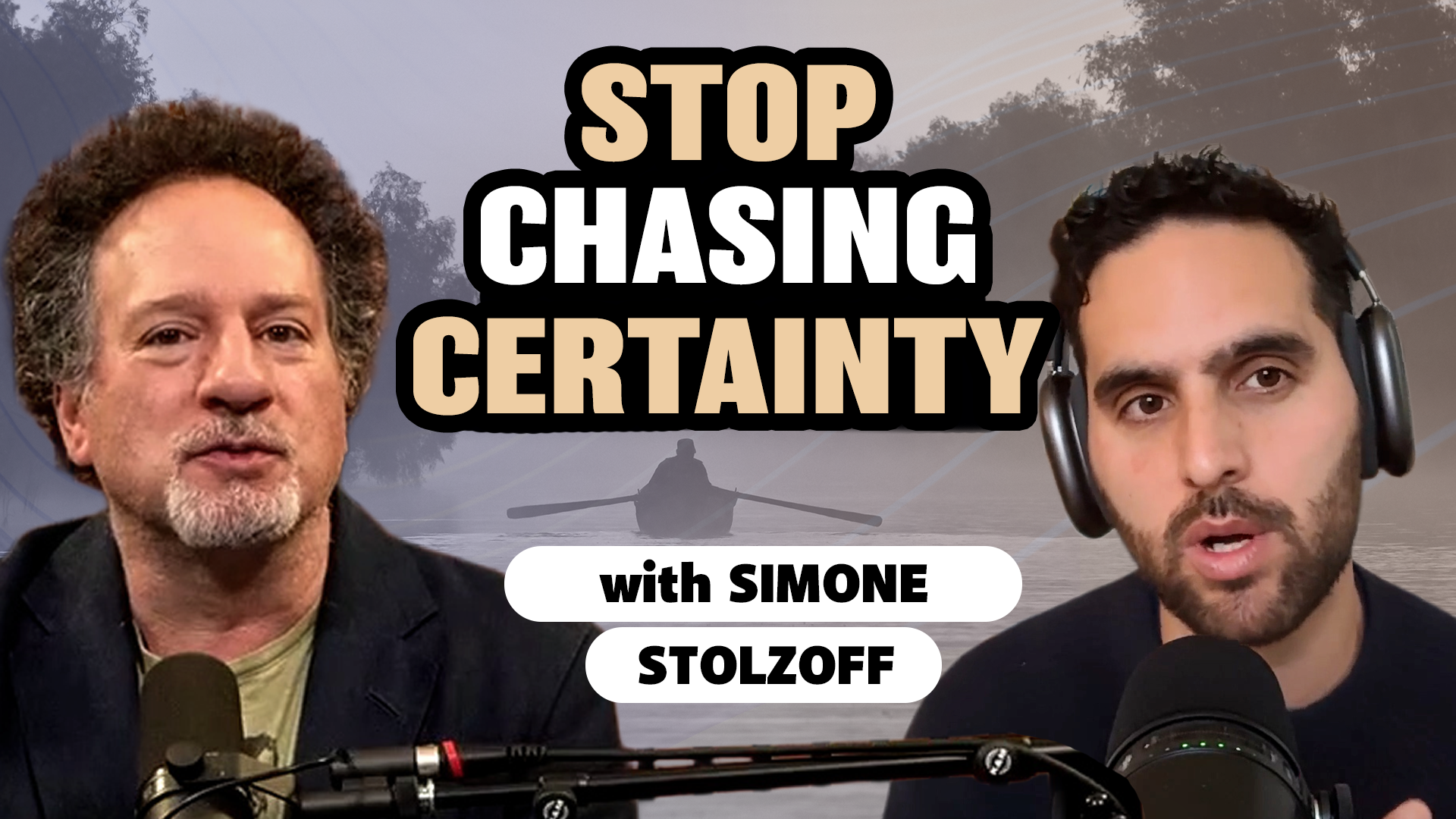
One of modernity’s great delusions is the belief that enough information can spare us from uncertainty. We endlessly scroll, analyze, and forecast in pursuit of the “right” choice — the perfect job, the smartest investment, the ideal candidate, the best life. But as Simone Stolzoff, author of How to Not Know, argues on the latest episode of What Could Go Right?, certainty is much less about our gained wisdom than our needed comfort.
The future, after all, is — and always will be — unknowable. Yet, over time, a feeling has emerged that it shouldn’t be. And that feeling paralyzes us; we delay decisions for fear of making irreversible mistakes.
But the reality is that most choices are not “one-way doors.” Careers do evolve. Relationships do shift. Companies do pivot. Paths reveal themselves once we embark on them, not before.
It’s why we shouldn’t frame optimism as confidence that everything will work out as planned; we can’t possibly know that it will. Rather, we should see it as a willingness to move forward, anyway. Because what we do know is that “wrong” decisions often lead to perfectly fine and sometimes spectacular outcomes.
In the end, as Simone says, making decisions the right way, not making the right decisions, is all we can do.
You can listen to our conversation in its entirety here, or read it below.
[TRANSCRIPT]
Zachary Karabell: What could go right? I’m Zachary Karabell, the founder of The Progress Network and the host of this podcast, where I talk to interesting and scintillating people about interesting and scintillating things, or at least I hope so. And one of the topics that has fascinated me and animated some of my worldview for years and years and years and years is the very human desire to know the future, this kind of need for certainty about future outcomes that is almost always flying in the face of the inherent uncertainty about most future outcomes.
Granted, there are some outcomes of actions that feel fairly certain. If you step off a curb into a deep hole, you’re probably going to fall into that deep hole because of gravity. But many, many aspects of our lives, if not most aspects of our lives, are shrouded in uncertainty that we as human beings try always to ameliorate or compensate for with false certainty about future outcomes, because it gives us some sense of security.
I was most struck by this in years of working in the financial world, where people would come for advice and want the assurance that if they invested their money right now, that in the future that money would grow or be preserved. There is nothing more terrifying than investing because of that uncertain outcome that maybe you’re going to lose your money.
Maybe entering a new relationship or a new job has some of the same, “Oh my God, am I making the right decision?” And so we all have to grapple with this in our own lives, and then we deal with that societally and socially. Are we collectively making the right decision? Do we support this politician or not? Do we like that company or not? All of these things we try to know future outcomes, even though those future outcomes are unknown, and we have yet to find a good way to deal with uncertainty in a world where we’re all cleaving to the desire for false certainty.
So today I’m going to speak with someone who, to my delight, has written a book about this, a book that I have been waiting for.
His name is Simone Stolzoff, and he has written a book called How to Not Know: The Value of Uncertainty in a World That Demands Answers. And under that general rubric, we’re going to talk about some challenging topics like climate change, like COVID, like how do you run a business? How do you decide whether to take that job? How do you figure out how to parent your children? All of these things fall into the category of we want the right answer, but is that right answer actually available to us? Or do we just have to surrender to the unknown and the fact that we cannot control the future?
Oh, and we’re also going to talk about death, and I am really excited to be having this conversation, or at least I am fairly certain that I am really excited to be having this conversation. But it may turn out that my certainty about that excitement was misplaced. Let’s hope not.
Simone, I am certain of very few things in the world, but I’m 100% certain that I am really jazzed to be having this conversation with you. I’m really curious. I know you talk about this a little bit in the book, but given that not everyone listening to this will have read the book, where did you get into this idea of, we are collectively as humans in our current moment in society not adequately recognizing our zealous and often problematic devotion to certainty?
Simone Stolzoff: Well, there’s the political answer, which is that in many ways our world is more uncertain than ever. There’s been some data that has showed that the five highest measurements of uncertainty since a few studies began in the early ‘80s have all occurred in the past five years. So you think about the pandemic, the wars and shifting tariff policies, et cetera.
But this also comes at a time when our tolerance for uncertainty is in decline. From the rise of mobile phones and the internet, I think lots of people have created the expectation that answers should be readily available. Maybe 10 years ago, I might’ve been okay not knowing the name of a given actor, and now I feel this almost involuntary need to reach into my pocket to find out. And so those are sort of the trends. There’s this sort of rise of uncertainty, decrease in our tolerance for uncertainty, and so many people are feeling anxious.
But there’s also the personal answer, which I actually don’t write about as much in the book, which is that I had an inciting incident for myself, which is, I was 28 years old,
I was writing for The Atlantic, a trendy magazine, and a recruiter reached out to me from this design firm, and I found myself at this career crossroads where there are these two potential paths unfolding in front of me. One was sort of Simone the journalist, the other was Simone the designer, and long story short, I was completely insufferable.
I was miserable trying to figure out my mind, trying to choose between these two paths. I asked everyone I knew. I asked my Uber driver. I asked my yoga teacher which job I should take. And in some ways it’s like, world’s smallest violin, the agony of deciding between two attractive job offers.
But in other ways, I realize now in retrospect that I was looking for certainty where there was no certainty to be found. I thought that if I just banged my head against the wall at the right angle, I would somehow know what my career will look like for the next 10 years. And I came to write this book because of my own discomfort with uncertainty.
Zachary Karabell: Did you make the right choice? By the way, for those who don’t know, Simone went to a firm called IDEO, which is one of the coolest design concept firms in the world, and they’ve created some of the more iconic things including, I think, the Swiffer.
Simone Stolzoff: Well, we worked on the Dyson. We worked on the first Apple mouse. It really had its foundation in product design. But to your question of whether I made the right choice, the answer is I don’t know. You can never sort of fully play out the counterfactual of the road not taken. And so part of my goal with the book is to help people get more comfortable making choices in their life in spite of the doubt, in spite of not knowing, and being able to persist nonetheless.
Zachary Karabell: I spent years in and out of the financial world. One of the things that is absolutely true of the financial world and financial advice is people wanting some certainty of, if I invest my money here, will I make money? Will I preserve my money? They want the certainty of future outcomes. Understandably, right? You want it because it’s risky, or it’s scary, or you don’t want to lose. So how do we offset that very human tendency, which is, I don’t want to make a decision and have the negative consequences lead me to second-guess and feel like I made the wrong decision?
Simone Stolzoff: Yeah. I mean, financial is probably one of the better examples of where people want a false sense of certainty, even if it isn’t actually accurate. There’s this one study that I write about in the book that I think is illustrative, which is these research participants were given either a fifty percent chance of receiving a painful electric shock or an a hundred percent chance of receiving a painful electric shock, and those with the fifty percent chance were far more stressed than those that had the hundred percent chance. We would somehow rather a certain bad thing happen than have to deal with the ambiguity of not knowing.
I mean, I think the most basic answer is that we have no choice but to live with uncertainty, whether it’s uncertainty in the markets or uncertainty about the future of your career or uncertainty about the world that your kid will inherit.
Part of what it means to be human is to have to make choices and to persist in the fog. I think the problem occurs when we grasp for these false senses of certainty. The pundit on TV that says, “This stock will definitely go up or down,” or the self-help guru that says, “If you just follow my 10-step plan, I’ll guarantee that you go to heaven.”
And this urge to find certainty is biologically wired within us. You can imagine one of our ancestors hearing a rustling in the bushes, and if they don’t know the source of that noise, that uncertainty could be lethal. The problem is, in today’s day and age, so many of us are looking for certainty where it doesn’t exist, whether it’s through our politicians or our financial advisors or the self-help gurus on Instagram.
And so the goal of the book is really to help people understand that not knowing is not necessarily a problem to be solved. And rather than try and reach for false senses of certainty, we can learn to get more comfortable with that which we don’t know.
Zachary Karabell: Yeah. This idea of, people will prefer a false sense of certainty over actual uncertainty is, you kind of come up against it over and over again. I wonder what you make of this. So one of the conceits of doing The Progress Network, doing this podcast called What Could Go Right?, for me, foundationally, was the work of this theoretical physicist, David Deutsch, who wrote a book called The Beginnings of Infinity. And in it, he defined optimism versus pessimism. And he basically said, and this is a paraphrase, and it may be a self-serving paraphrase, but it’ll work for this interview, that optimism is not the certainty that the future will go well. It’s the humility that we don’t know future outcomes, that there’s a huge spectrum. Karl Popper talked about this too, that the pathways of the future are infinite, and that we have a role in the present in shaping them. But that pessimism is often the hubris — and I’m using the word hubris because you use it in the book — that we can know future outcomes and that we do. So I mean, I wonder, does that resonate with you in terms of how you think about these things?
Simone Stolzoff: I love it. Yeah, you can kind of think about uncertainty as this inflection point, where right now, the most common reaction to uncertainty is fear.
It’s to see uncertainty as a threat, to think, “If I don’t know, then that means that things will necessarily go bad,” and we have this natural tendency to catastrophize or think about all of the worst-case scenarios. But what I try and argue, and I think this is very much in line with The Progress Network and what you’re trying to do with the show, is that uncertainty is also the birthplace of possibility. It’s also the precursor to things going well. And if you think about any sort of scientific breakthrough or generational company or even a genre-busting original piece of art, they all came from someone’s willingness to get to a point where they didn’t know what was to come and to continue on.
There’s an example I really like that I actually don’t write about in the book. It comes from this entrepreneur who in the early 2010s had this gaming startup called Tiny Speck, and it was sort of the darling of Silicon Valley. Everyone thought it was going to be the next big thing, and it raised tens of million dollars before it launched. Its launch was covered in The New York Times. It had all of these active players from the get-go. And yet, less than two years into building the company, the entrepreneur did something that other people thought was crazy, which is he decided to shut the game down. He offered to make his investors whole. He gave his employees the opportunity to leave, and then with the employees who were left, he said, “Okay, let’s pivot. Let’s try a completely different product in a completely different industry.” While they were building the game, they had this internal communication tool that they had built as a team to help collaborate across different offices, and that tool became what we know today as Slack. And that entrepreneur was Stewart Butterfield. And of course, Slack sold for, I think, almost 30 billion dollars to Salesforce.
But I think it goes back to your definition of optimism. Butterfield didn’t know that the future would necessarily turn out rosy, and of course the fact that the company succeeded is a nice bow on the case study, but what he was willing to do is turn toward his uncertainty and be willing to explore what this new opportunity might provide. Without being willing to turn toward what he didn’t know, he wouldn’t have been able to discover the possibility. It’s what statisticians often call “transcending a local maxima.” Often we’re sort of standing on top of a peak, and we think we’ve reached the top, only to find out that around the corner there’s an even higher peak that we could reach. But in order to reach that higher peak, we need to be willing to descend the mountain. And I think that’s what optimism allows us to do.
Zachary Karabell: Okay, well, what about the people who will hear that story and say, “That’s only a good story because it turned out well, because he pivoted to Slack as opposed to pivoted toward the company imploding?” Because the thing that people don’t like about uncertainty is not that it’s uncertain that you might succeed beyond your wildest dreams, it’s that you might fail commensurate with your deepest fears. So what do you say to people about that?
Simone Stolzoff: Of course, those are both part of the possibility landscape, right? But often what keeps us paralyzed, what keeps us from even stepping towards the unknown at all, is the fear trumping the possibility. And rather than be this sort of ideal of, “Oh, you’ll always turn out well,” understanding that, yes, there is the risk, but there’s also the possibility of reward, is our way of balancing the scales.
Zachary Karabell: Are we still allowed to use the word “trumping” as a verb? Is that, is that kosher?
Simone Stolzoff: I think so, in certain environments, and it’s a podcast, so we can edit it out later.
Zachary Karabell: That’s right. May or may not make the final cut.
Let’s talk about, I think, a controversial aspect of this. One of the sacred cows of probably our communities is that there is a clear and present danger that man-made climate change represents the greatest, not just existential, but actual threat to human life on the planet in the 21st century, and that we are headed down a perilous path of much more accelerated global warming than is tenable, and that if we don’t do something right now, a series of increasingly catastrophic things will happen in terms of our lived environment.
Those statements are statements based on science, but said with a great deal of certainty about future outcomes. So how does that fit? What do we do about the way in which our understanding of what is a threat is predicated on certainty of future outcomes?
Simone Stolzoff: Yeah. I am glad you asked. I talked to a few climate scientists and also climate psychologists for the book, people who help people manage the anxiety of climate change, especially young people.
And the thing I learned is that the thing that will help address the climate crisis is also the best thing to help manage your anxiety, which is taking some sort of action. There’s this common phrase in the psychology community that action absorbs anxiety, and so through the doing is how we get more clarity.
Now, with something like climate change, yes, the forecasts are a lot of doom and gloom. I don’t want to just have my California paint over all of the bad things that are potentially waiting for us on the horizon. But the thing that will give you as an individual hope, is thinking about this whole tapestry of climate solutions and then thinking about the one string that you might be able to pull on.
This isn’t to say that if you just recycle, the world will magically fix itself. But understanding how you might be able to play a role and not let your anxiety about what the future might hold keep you from doing anything. And so in my mind, optimism isn’t necessarily the idea that the world is headed towards a more beautiful place or that the future is necessarily better than the present, but it’s this idea that we all have agency to help shape what that future becomes.
I think one of the best examples for not wanting to have a fixed idea of the future is that if you want to change the world, you shouldn’t want the future to be already written. You want to be able to write your part in it, and that’s what I think about in terms of the climate movement is, you have to be part of that solution even, and especially, if you are sort of down or feeling a little paralyzed by the size of the problem.
Zachary Karabell: I think it’s Karl Popper who said something like, “The pathways of the future are infinite, and it is up to each of us not to prophesy doom.” And he is basically saying in a more elaborate mid-20th century European fashion exactly what you just said. That it’s kind of incumbent on us to write the future. It’s not written.
I do want to push on this, though, because clearly there are certainties that are certain, right? If you hold your hand over a flame, you are within a realm of almost-certainty to get burned. If you jump off a cliff, you are within a realm of almost-certainty to plunge to your death. We kind of think the sun is, quote unquote, going to rise tomorrow. We now know, of course, the sun doesn’t rise. The Earth just makes its way around the sun and rotates accordingly. But for better or worse, we kind of say it will rise tomorrow barring something catastrophic, in which case it won’t really matter that it won’t because we won’t be around to witness its absence. Those are certainties, or at least those are as close to certainties as we can get, and you’re clearly not arguing in your book that there are not certain things that are certain, right?
Simone Stolzoff: No, not at all. And in fact, having certainty about some aspects of your life makes it easier to hold uncertainties in others. Getting clear on what those facts are, or the fact that you are committed to live in a particular place or you’re committed to a particular partner, actually makes it easier for you to hold uncertainty in other facets of your life. This isn’t a book where I’m advocating for the sort of full anarchy mode of just, turn toward uncertainty, look for chaos wherever it may lead. It’s an argument for the value of not being hubristic, of not deluding ourselves into thinking we can be certain about things that we can’t. But that is different from thinking that we can’t be certain about anything.
Zachary Karabell: So I’m going to keep going on this climate change problem insofar as it relates to the matrix of your book. And for those listening, I am not questioning the science, I’m not questioning climate change. I’m questioning the dotted-line assumption of where this all ends up. Now granted, it is a dotted-line assumption of where all things end up if we don’t do things to change that trajectory.
But isn’t that the problem of a lot of scientific hubris or a lot of human societal hubris, which is, we extend the “all things being equal” argument into the future as if there will not be multiple new variables and countervailing factors, when observably, if you look at the past, that’s kind of always been the story of human existence on the planet, which is things have never just been all things being equal. So why should it be the same for the arc of human-caused climate change?
Simone Stolzoff: You kind of hit the nail on the head there, Zach. In many ways, the way that scientific institutions lose credibility or trust is being overconfident in things that they don’t necessarily know to be true and presenting them as certainties as opposed to probabilities, or things that come with their own confidence intervals.
I think AI is another great example of this. I feel right now we’re in this moment where we have a tendency to either lionize or villainize this technology. And half of the entrepreneurs say it’s going to lead to this age of creative expression where all rote tasks will be automated, and we’ll be able to write poetry and leap around in fields.
And the other half say, class warfare is inevitable, and it’s going to lead to this growing resentment of people who aren’t able to take advantage of this wave, and the robots are going to show up with pink slips. And the truth is, one, the truth probably lies somewhere in between those two poles. You know, there is a middle path.
And two, to your earlier point, there will inevitably be black-swan events or things that we can’t anticipate that will change everyone’s idea of these sort of linear predictions and extrapolations into the future. And we shouldn’t have the hubris or the overconfidence to think that what we know today is all that we’ll ever know, and that the graphs and forecasts that we make in 2026 will necessarily be borne out exactly as we predict.
Zachary Karabell: Let’s talk a little bit about that in terms of jobs, because you did an earlier book called The Good Enough Job. Somehow I kind of love the German title of the book, of Dein Job ist gut genug! I don’t know why I like that. It’s just, somehow, I think we should all refer to that book by its German title. You wrote that a bit before the crescendo of “AI is coming for your jobs” had reached its current fever pitch, but that does raise this question of, what’s the purpose of a job? Are we basically working to live, or are we living to work? And one of the utopian promises of AI was that it would liberate people from crappy jobs. One of the dystopian fears of AI is that it will eliminate jobs that people otherwise actually want to do. How much of this do you feel is temperament? How much of this is, some of us are glass half full, some of us are glass half empty, as opposed to there’s a right way or wrong way of looking at this?
Simone Stolzoff: Yeah. Upton Sinclair said something like, “You can’t convince a man about something when his job depends on him not understanding it.” I think there’s a lot of sort of built-in biases and incentives that influence people’s views on this. I mean, the truth is that no one really knows what AI will do to jobs over a longer time horizon. And the sort of most accurate view, I think, is to not try to forecast or project into the future.
The argument in my first book was really about the value of diversifying our identities, treating work as part of, but not the entirety of, who we are. And it wasn’t on either pole. It wasn’t saying that work is a necessary evil. It wasn’t saying that work is necessary in order to self-actualize. It was saying that work is a great contributor to identity and community and purpose, but it shouldn’t be the sole contributor to those things in your life.
And I actually think that same sort of diversification argument is very relevant when it comes to uncertainty. If we can’t know exactly what the future holds, we can treat our life like an investor and have sort of a diversified portfolio of meaning in our life, have a diversified portfolio of options and sources of community. And rather than making one bet or putting all of our chips on one particular future, we can understand that a more broad foundation of who we are allows us to be more resilient and adaptable in the face of change.
I think often, because I wrote a book about work, I’m asked at talks to give my predictions about how AI will impact jobs, and what I really want to say is, you know, throw my hands up and, even the chief economists at these frontier labs are really pulling things out of a hat. We don’t know what the long-term consequences are going to be.
But the advice is to focus on the realm that we can control. Separate the sort of macro trends that you have no influence over from the micro things that are actually in your sphere of influence. And do things like try to get to know the tools themselves so you can be proximate to what is maybe causing you a lot of fear. Try to position yourself to be indispensable in your company. But also try not to be overly wedded to any particular vision of the future. That’ll make you more brittle or fragile or susceptible to be blown over by a strong gust of wind.
Zachary Karabell: So we talked a bit about the, at least as it applies to science, we talked climate change, the hubris being a problem of the certainty matrix. Probably could’ve said some of the same thing about COVID in 2020. Meaning, too much hubris about certainty kind of undermines even the underlying validity of the message, or it changes the equation for how people are going to hear it.
But what’s wrong with a little bit of the comfort part? You talk about one of the reasons people like certainty is because there’s a comfort that comes with it. You know, we do this when we raise kids. There’s a certain false certainty that we allow for that is staged, right? We don’t plunge a 4-year-old into, “Sorry, you’re going to die,” or “Life is pain. Get over it.” We tell stories that allow for a gentler glide path into some of the difficulties of life. We tell ourselves stories about a new job, that it’s going to be the perfect job. We tell ourselves stories about a new relationship, that it’s going to be wonderful. And often those things are true, and as we know observably, often they’re not. But if we go with the often they’re not, that often precludes constructive action. It’s some of the comfort, right, of telling ourselves a story about the future that may not be certain, but we’ll go with that certainty because it propels us forward. So is that a problem?
Simone Stolzoff: The problem is when comfort comes at the expense of learning and growth. If we stay stuck in our bubbles of comfort and never expose ourselves to things that might make us uncomfortable, then we’re never expanding our horizons. I think a good example is someone who is stuck in a job that they know isn’t right for them, or someone who’s stuck in a relationship that they know isn’t right for them, but values the comfort of the status quo over the potential threat of the uncertainty of leaving that job or leaving that relationship.
I don’t think comfort is a problem in and of itself, and there are certainly benefits to the sort of climate-controlled rooms and comforts of daily life. And yet, if we are too comfortable, if we’ve just exploited all of our preferences, it, one, makes us ill-prepared for the inevitable moments in our life where we’ll have to be resilient or bounce back. Two, it keeps us from knowing whether there’s something that’s better out there for us. I think about someone who always orders the same thing at the restaurant and never knows that there’s a dish down the page that they might like better. And three, I think part of what it means to be in a collective society means addressing your discomfort head on. I think one of the reasons why we are so polarized right now is that people aren’t willing to face the discomfort of a conversation with someone who maybe voted for a different person than them, or face the discomfort of what it would mean to actually expose yourself to the type of risk of, say, being young and striking up a conversation with someone that you don’t know whether or not they like you. And so comfort can be a great blessing of the world, but it also can come at the cost of our ability to learn and grow.
Zachary Karabell: The role of a writer is always to take a step out and comment upon, but you’ve also been involved in a firm. Companies and reporting structures demand that you meet your goals. You set your goals, and then you meet your goals. That’s kind of a flag of future certainty, maybe short term. If companies were to embrace some of the mantras that you are laying out, and mantras which, by the way, personally I love and I think are vital and important, what would that look like, and how would that shape things, and would it work?
Simone Stolzoff: Yeah. No one wants a leader that just throws up their hands and says, “I have no idea what the future holds.” I think we need to be willing to make bets on the future. In my mind, what a progressive leader espouses is someone who’s willing to admit what they don’t know, admit what experiments they’re running to try and figure out that information, and also be clear about what it is that they do know. I think that IDEO is a great example. We did product innovation consulting, and we didn’t necessarily know at the beginning of a project what we would build, because the whole idea is that we do this sort of human-centered design. We go out into the world, we talk to users.
And the metaphor that I really like that was told to me by one of my former bosses is that being an innovator is sort of like sitting in a rowboat on a lake that’s shrouded in heavy fog. You might not be able to see very far in front of you. You might not be able to know exactly where you’ll end up, but you have two jobs. One is to have faith that you’ll eventually reach land, which I think in some ways is sort of the MO of a show like yours. And two, you have to keep rowing, and it’s through the rowing that the clarity emerges.
And so if I were to think about maybe a more accurate CEO earnings statement, it would be less about 10-year projections of exactly where we know the market will go. It’ll be about, this is what we believe. This is sort of our confidence interval associated with it. This is how certain I feel about this particular bet or this particular future, and this is the way in which we are running experiments while staying open to the fact that our beliefs might change over time. So rather than sort of the blind faith that a guru might try to instill amongst its subjects, I think the best CEOs or leaders instill a type of conscious faith. Which is to say, they are inspiring enough to put a bet on because of their willingness to separate what they know and what they don’t know.
Zachary Karabell: It’s funny, when you were talking about the boat analogy, I had this flash of Magellan talking to his nascent crew or trying to recruit a crew. Like, we’re going to just set off. We’re going to circumnavigate a world that until a few years ago all of you thought was flat anyway. We’re going to go out there, there being who the hell knows where, and observably from other people who’ve tried to do similar things, most of you aren’t going to make it. But come! Come with me.
And that’s a very different worldview and mentality than you would find in early 21st century United States or Europe. Meaning, talk about an embrace of radical uncertainty. Of course, I guess we could look at it by saying, the certainty of near death being, not precluding embracing the fact that maybe something else could happen.
You open this a little bit like, there’s a cultural moment, that we have become dependent on false certainty. Do you feel this has just radically changed over your lifetime, our lifetimes, slowly over the centuries? Because again, clearly generations of humans were able to exist under conditions of much more radical uncertainty. Maybe because they just had no choice, right? Certainty was not an option.
Simone Stolzoff: Yeah. And even humans today, I would be loath to give a copy of How to Not Know to someone who’s fighting on the front lines of the Ukraine war right now. Like, there are levels to this, and if you were living in Florence during the Bubonic Plague, you might sort of scoff at contemporary notions of what it means to live in uncertainty.
But that doesn’t change the sort of felt experience of uncertainty. I think part of that is due to the information economy that we live in. We can now track the real-time changes of a conflict happening on the other side of the globe, or put a tracker on our children and have the expectation that we should always know where they are. And part of that is just the way in which our expectations have risen, where we believe that certainty is more possible than ever because we have these tools to forecast.
Zachary Karabell: And COVID was a profound example of that, right? We were able to track, morbidly, who was dying where, in what micro part of a city, in what country, and then compare them as if somehow this was going to give us absolute clarity about policies we would’ve had, as opposed to every other point in human history where when disease befell society, it took a long time, if ever, and probably never, before you figured out just what had happened and maybe what you could’ve done about it.
Simone Stolzoff: Yeah, and I think this is one of the things that Fauci has written about and said that he sort of regrets from the early days of the pandemic, is having to give people a certain policy recommendation and project that he is more certain than he is. Things like mask mandates, or standing six feet apart, or washing our groceries, what have you, they were all born, in some ways, out of politicians’ or leaders’ need to give people a toehold, to give people something that they can be grounded in in spite of the not knowing. But the problem is, when you rush to make policy decisions about, we must wash our groceries, or we must make sure that we’re not touching banisters because COVID can spread on the railing in the supermarket, it erodes trust over time.
And I think that’s the risk of being overly certain or overly confident. I actually think some of the AI CEOs and leaders in the space are showing some humility when it comes to their projections of the future. Certainly you see Dario from Anthropic saying, “Okay, fifty percent of entry-level jobs will disappear in the next five years,” or some of these more extreme claims.
But even as a technology itself, the people working in these labs don’t know exactly how it works. And so I see a little bit more sort of measured optimism coming out of Silicon Valley these days than maybe you’d see in the Mark Zuckerberg and the birth of the iPhone days, about how we are changing the world and techno-optimism, it’s inevitable that everything is going to get better. I do think the sort of measured approach of, we only have so much control and it’s incumbent on us now to be thinking about these risks is a welcome balance to some of the sort of blind optimism that you’d see coming out of some of these CEOs in the past.
Zachary Karabell: Well, it’s interesting. In Dario Amodei’s twenty-five thousand thirty-word piece in February of 2026 about his view of the landscape of AI. But he was also highlighting risks more than opportunities, and he had a whole section of the risks of the unknown unknowns as opposed to risks one could forecast. That was in the context of, there are even worse things that could happen that we can’t even fully foresee. It was less about, there are all these great things that could happen that we couldn’t fully foresee. I’ve wondered about the collective certainty about negative future outcomes that seems to be nearly ubiquitous. There’s not that much techno-optimism. I mean, maybe there is amongst a group at dinner in Pasadena. But in general, you wouldn’t exactly call our current culture techno-optimist. You would call it techno-pessimist.
Simone Stolzoff: There’s a term for this, which is called “bracing for the worst,” which is basically when we don’t know exactly what the future holds, it is somewhat psychologically adaptive to imagine the worst-case scenario and then hopefully be pleasantly surprised.
So the canonical example is you’re sitting in class, the teacher is passing back the tests, and you think, “Oh, I failed. I’m definitely failing this test.” And that sort of little story that you tell yourself is a way of emotionally preparing for you to get the actual result, and then hopefully you’re pleasantly surprised.
The problem is when that sort of bracing for the worst turns into catastrophizing, where all you can imagine is the worst-case scenarios, and that becomes a source of paralysis where you’re not even willing to make a move. There was this one psychologist I talked to for the book that really changed my mind on these things. He said when people are really intolerant of uncertainty, they tend to have one of two responses. One response is the one that we probably would anticipate, which is people become obsessive information gatherers. So you’re in a store, you’re trying to buy a pair of jeans. If you’re really intolerant of uncertainty, maybe you try on every single pair of jeans in the store before making up your mind. But there’s also another response, which is, people can become very impulsive, which is its own sort of avoidant behavior. You just buy the pair of jeans in the window because you don’t have to wrestle with the uncertainty of whether it’s the right one. And I think a more adaptive point of view is some sort of middle path where maybe you try on three pairs of jeans and figure out which one you want to wear.
And so I think that’s the problem with the sort of hyper-doomerism or bracing for the worst and only anchoring yourself in the worst case scenarios, is it doesn’t allow you to see the sort of other side of the uncertainty coin, which is what might emerge if you’re willing to put yourself out there, if you’re willing to see a more optimistic future.
Zachary Karabell: It’s funny, I was thinking, and kind of back to the COVID part, because there was also a part which we all did, and I certainly did obsessively, which is, because we had all this information at our fingertips, we had the corpus of human existence. We had all this real-time data. And those of us who were so inclined spent a lot of time trying to get as much data as we could about COVID. Who was it harming? What ages would it likely harm? What demographics? What preexisting conditions? What countries’ policies seem to be working or not working? And doing all this in kind of real time. And I think that probably falls into your category of control, right? That we somehow felt that if we could just assemble enough real-time information, then maybe the real world consequences of this could be ameliorated or avoided or changed. Certainly, during the Bubonic Plague or during The Great Flu of 1919 to ‘21, that just wasn’t an option, right? We didn’t have that transparency, didn’t have that information, so you couldn’t really exert that control. And I wonder, looking back, was that control — did that do us any particular good, or did it both psychologically make it worse and made no difference whatsoever about the outcomes?
Simone Stolzoff: Yeah, I think about this a lot in the context of parenting. I recently became a father for the first time. There’s such a tendency to gather information as a way to exert control onto a situation that you might have less control than you think. There isn’t always a one-to-one input to output when it comes to babies and raising kids of you’ve put in so much effort, and you don’t necessarily get the same rewards.
And I know just recently, thinking about something like sleep training, I felt this tendency into myself where I just wanted to read every single book about sleep training, and read every article and consult three different experts, rather than actually kind of getting into the arena and trying things out.
And I think that the problem with that tendency to gather endless information, is when you spend all of your time reading the reviews for all the plastic water bottles that you might be able to buy on Amazon is, it’s costly. It’s costly in terms of how much time you spend doing it, it’s costly in terms of mental health, and it’s ultimately costly because the opportunity cost of whatever you choose becomes that much more apparent. It’s really easy to sort of play your own devil’s advocate. And so I think a lot about this distinction that is often attributed to Jeff Bezos about the difference between one-way door versus two-way door decisions. One-way door decisions being the harder decisions to reverse, and two-way door being the decisions that you can make, and then if you realize that you’ve made a mistake, you can course correct or sort of walk back through the door.
I think today so many of us try to make two-way door decisions using a one-way door decision analytical framework. And we sort of over-engineer our own decision-making.
Zachary Karabell: Yeah, parenting is absolutely the most pure and often the most fearful iteration of that, right? Like, I’m going to make the wrong decision, and that wrong decision is going to be irreversible, right? So parenting unfolds culturally as an endless series of one-way door decisions, when in fact, as I’m almost certain you will learn as a parent, it’s an endless series of, two, three-way, one day you’re stuck in a room with no exit, the next day there’s only doors. It’s continually confusing, but it’s rarely, this one decision is going to determine everything that follows. But it’s presented as if, right?
Simone Stolzoff: Yeah. I think there’s a great analog in career choices. I think so many people sort of white-knuckle-grip decisions about what job to take, myself included, because we believe that the future will be completely determined by this one decision you make, fully discounting our ability to course correct or the things you might learn even if you go down the wrong path.
And I think that is sort of where certainty rears its ugly head, is if you think you can be certain about these decisions about the future, it puts an incredible amount of pressure on you to get things right, as opposed to the empowerment that comes from the knowledge that you can make the decision right, as opposed to needing to make the right decision.
Zachary Karabell: That’s a good way of putting it. I think about this a lot in terms of, I mean, you’ve thought about this in writing books and picking a book topic, and sometimes you’ll tell people you’re writing a book, and it will feel like this decision of great gravitas, and it is. It’s a commitment of time and energy and life. For myself, I always said to people, and I always said to myself, “Hey, it’s just a book.” It’s not your life. It’s not going to determine — I mean, it may determine in constructive ways the arc of your life. It’s much less likely, actually, to determine in destructive ways the arc of your life. So it’s a lot of upside. It’s not a lot of downside. But it’s just a book.
And one last thing I want to touch on, which is very apropos all of this, which is particularly in a world of AI and personalized medicine, is this sort of move toward, particularly right now amongst elites in Silicon Valley, this longevity movement. Because one of the only things that we do know for certain, at least observably, is that we’re all going to die. We don’t know when we’re going to die. There’s a new app called Death Clock, where you’re supposed to type in 29 variables, and it tells you... I found this incredibly creepy, by the way, it tells you when you’re going to die, and then it gives you a program to extend that. Talk about trying to give people a certainty to the day. And you have this whole movement and people spending millions, if not more than that, on how long can we live? How much longer can we live relative to what we might have been living, which actuarily we know collectively, but none of us know individually. Is that in the kind of hubris and control matrix that you’re talking about? Have you thought about this given that you live in the heart of all this?
Simone Stolzoff: I think about it in terms of control all the time. Death is the one certainty that we all share, and yet we don’t know how or when it’s going to happen, which is one of the greatest sources of anxiety in people’s lives. And there’s a huge cost in this sort of death-denying culture that we live in. And it doesn’t even have to be the Bryan Johnson extreme, sort of don’t die movement.
But without reckoning with our mortality, we lose out on the clarity of how we want to live. Not to say that taking two dozen supplements every morning, and then doing red light therapy, and then going in your cold plunge, and then going to your longevity doctor is a waste of time in and of itself. The sort of philosophical underpinning of this whole movement is often denial of the very fact that makes our lives meaningful, which is to say, that because we know our time here is finite, it can be an incredibly clarifying force of how we want to spend it. But if we are under the false impression that we can live forever and we’re going to spend all of our energy trying to extend that potential end date as much as possible, we lose out on the benefits of the stakes of knowing that we won’t be here forever.
And so I don’t think there’s anything wrong with wanting to increase your health span, or try and think about how you can use some of these tools to make you more comfortable or to keep your body functioning at a high level for a longer period of time. But I just think that this whole movement of trying to live forever is most costly to the people who are most invested in it, which is the people who are denying the most basic fact of our existence, which is the fact that we’re going to die. Not to mention all of the practical costs of living in a culture where we think we’re going to live forever, and so we don’t prepare for death, and we often leave our loved ones to clean up the mess after we’ve gone, and the enormous red tape that you must go through if you haven’t thought critically about the fact that you’re not going to be here forever for your loved ones and your extended family.
I just think this longevity movement is completely misguided, and people spend so much time on maybe trying to increase the one percent difference here and there, whereas the baseline things about what makes us healthy, like having a social life and eating well and exercising, are not too complex, and they don’t need entire industries to be engineered around.
Zachary Karabell: So what about this world of like hard-charging — and this segues a bit with the book you did, The Good Enough Job — hard-charging people, hard-charging companies, hard-charging states and politicians, societies over time that have been fueled, and change has been fueled, and innovation’s been fueled, and discovery’s been fueled, by a set of people willfully, hubristically, controllingly believing that they’ve got the idea. They’ve got the key, the secret to tectonic change that’s going to make them rich, that’s going to make all of us wealthy, healthy, strong, successful. And that if you adopt a more balanced philosophical, almost Zen-like humility, letting go, relinquishing control over the unknown, that may create a degree of inner peace, but it will freeze or halt or enervate or undermine all of those powerful forces that I just talked about that seem to fuel so much of what human beings do.
Simone Stolzoff: Yeah, it’s a beautiful question, and maybe part of Elon Musk’s hubris is what allows him to send rockets into space. I think it’s, again, a case of not being fully on one extreme or the other. One other example of someone who is completely connected to a vision of the future is any cult leader ever. It’s this peddling of an idea that if you just follow this particular protocol, I can guarantee you to get to heaven, or to have financial success, or whatever dream you might want to accomplish. And the allure is that it’s attractive to outsource your worldview, to buy one off the rack, to just follow someone else’s plan for how the future might go.
The problem is it’s easy until it isn’t, until your fixed idea of the future comes crashing down into the messiness of reality. And so I do think we need some of these visionary leaders to take bold bets on the future or just declare we’re going to go to the moon before we’ve actually done so before.
But it has to be balanced out with an openness to be able to change your mind based on changing information. And I think that’s what’s special about this moment. It’s just the pace of rapid change, and if you declare as the CEO of Blockbuster Video, that people are going to continue to rent VHS’s forevermore, that is the type of hubristic thinking that can keep you from seeing the market or the world or the conditions change around you.
So I think we need a bit of both. I don’t mean to poo-poo people who want to change the world, but hopefully it’s with a level of humility that allows them to see the reality as it emerges.
Zachary Karabell: I’ve got to admit that I occasionally miss Blockbuster Video. I miss being able to go into a store, trying to figure out what you’re going to watch, the uncertainty, the unknown of, is the movie you want going to be there? Is it not going to be there? Are you going to have to find a movie you didn’t think you were going to watch? Is it going to be terrible? Are you not going to watch a movie at all? All that was kind of fun.
Simone Stolzoff: Totally. That’s the magic. That’s the serendipity. That’s the surprise. And now it’s the opposite, where you watch the trailer, and you read all the Rotten Tomato reviews before you even step into the theater, and it creates a little bit less of that potential magic or delight.
Zachary Karabell: And there’s infinite choice and no scarcity, which is a whole other question about what do we do about all that.
I want to thank you for your insights and your time. What’s next? I know this is what’s next. But when you think about your next few years, you’re a new parent, you’ve written a couple of books that have caught fire, have you found your groove? What do you think?
Simone Stolzoff: Yeah, I think it would be antithetical to my thesis to say I know exactly what’s to come. But I do love the process of writing books. I feel very grateful. And even living in one of the most expensive cities in the world as a writer, I do get that sort of doubt, or the creeping in of, should I be optimizing for financial stability? Should I go join OpenAI and become a marketing guy to find some of the comfort in knowing exactly where my next paycheck is going to come? But the thing I always come back to is, part of the fun of being an author or being self-employed is the figuring it out, and I am not quite willing to leave this pathless path quite so soon. I don’t know exactly what the topic of my next book will be, but I hope it’s something that follows my curiosity and I stay open to seeing where my curiosity takes me next.
Zachary Karabell: Pathless path, good phrase. Nicely done. Thank you, Simone.
Simone Stolzoff: Thanks for having me, Zach.
Zachary Karabell: Well, as expected, my false sense of certainty at the beginning of the conversation that I was going to like that conversation in this case proved to be true, but don’t let that be a guide for future certainty.
I want to thank, as always, Kaleidoscope for producing these episodes, and I want to thank my team at The Progress Network for supporting all of it, and I want to thank all of you for listening and for your time.
Please send me your comments and your ideas. Go onto theprogressnetwork.org website or to my Edgy Optimist Substack and send me a note via that way. Comments, criticisms, suggestions, all are welcome, and your time is valued. And we’ll be back with you next week. Thanks.
I do like that, "It’s why we shouldn’t frame optimism as confidence that everything will work out as planned; we can’t possibly know that it will. Rather, we should see it as a willingness to move forward, anyway. Because what we do know is that “wrong” decisions often lead to perfectly fine and sometimes spectacular outcomes."