
The Cassandra Complex
Why America’s flaws don’t yet add up to fascism.

A few weeks ago, an article in The New Republic drew attention to the “Cassandras” who early on warned that Donald Trump was a fascist but were dismissed as hysterical alarmists. The tenor of the piece is that the past year has proved the Cassandras right and that those who routinely downplayed those risks have, as Ricky Ricardo might have said, “some ’splaining to do.”
Among those the author cites as complicit in the dismissing of those who warned early is … me. “And then there were those who were openly angry with the Cassandras. Trump couldn’t become a dictator, Zachary Karabell told us in Politico before the 2016 election. We should think of all the checks and balances ‘before we get too breathless about impending fascism and the end of America as we know it.’”
To be clear, I did indeed write that.
The article also suggests that many of those who did not sufficiently rise to the gravity of the threat tend to be white, male, educated at elite schools and live in major metropolitan areas.
To be clear, I am indeed white, male, went to an elite school and live in New York City.
The article is extensive and meticulously researched, but it hinges on the assumption that we are now living in a quasi-fascist society. For all the use of the word fascist, no one seems to be able or willing to define what it means. It clearly doesn’t mean that the United States is about to become like Mussolini’s Italy or Hitler’s Germany. It doesn’t mean that we are going to look like North Korea or Iran. Or China or Turkey or Russia.
It does suggest that the rule of man will replace the rule of law, that the whims of those in power — and not the constitutional process — will dictate law. It might also suggest that individual freedoms will be violated, presumably in a way that they have not been violated in the American past; if such violations occurred before, it would be hard to make the case for fascism now unless one made the case for fascism then.
I along with many others have routinely over the past decade pushed back against the notion that Trump represents an existential threat to democracy. But I have pushed back with the full acknowledgement that if he could do what he wants to do in the way he wants to do it then, yes, that would be a threat to many aspects of American freedom and democracy.
The thing is, he can’t.
Courts have ruled for the administration, but they have also ruled against it — and those court orders have been obeyed. Congress has overwhelmingly caved to White House wishes, but not always. Yes, the administration has pushed the boundaries of what a president can do. But that is not an executive running roughshod over the system. It is the system functioning and producing outcomes that a majority of Americans think are wrong. And all of it will be contested in the midterm elections in 10 months and then in the presidential election in 34 months. That is not fascism. That is American democracy.
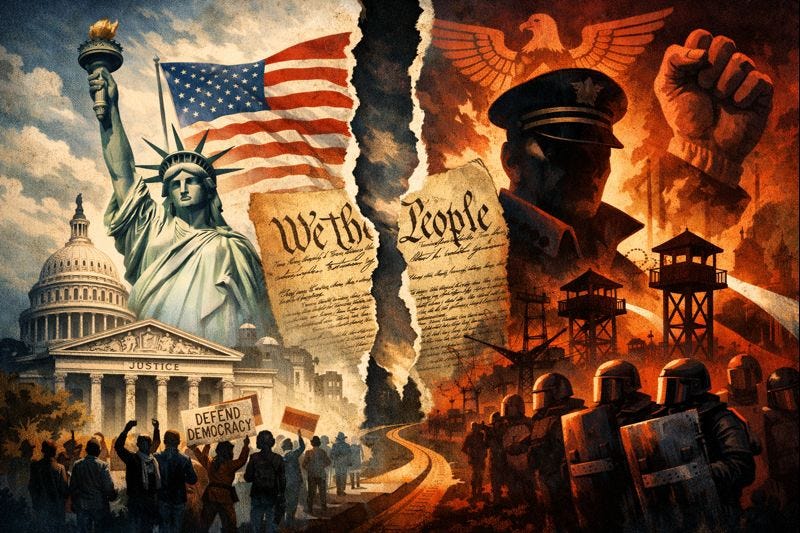
The rejoinder to that is generally “not yet” or “just wait.” In another piece that I did for Politico in 2017, I said that Trump’s team was so inept that it had, to that point, actually diminished the power of the presidency, but that if, like George W. Bush’s administration in 2002, it became more competent, perhaps it could enact more radical policies. I thought that the ineptitude would, in fact, be good for democracy, and the next few years proved that out. Not even the Cassandras were suggesting in January 2021 that it was likely that Trump would be elected again in 2024. You can’t use the past year to say that some people knew it all along. No one knows the future, and Trump’s return to the Oval Office was not on many bingo cards in early 2021.
The cast of the second season of The Trump Show has clearly learned from the first. Russell Vought at the OMB has been particularly adept at using the powers of the presidency to shape the federal bureaucracy, far more than the clumsy sledgehammer wielded by Elon Musk and DOGE did. And this time, Trump’s tendencies have faced little internal pushback.
Yet, a year in, we most certainly still have a nation of laws, and we are most certainly still a nation of flaws.
Much of what Trump has done was already done in the past. True, no one did all the things the Trump administration has done to the degree that it is doing it, and no other administration has attempted such a broad redefinition of the power of the president over the executive branch, as this one has with its expression of the “unitary executive.” But the same judges who validated that theory, especially the Supreme Court’s Neil Gorsuch and John Roberts, also ruled powerfully in the Chevron case in favor of curtailing the power of the executive branch to regulate. We will see how this all plays out, but it is way too soon to assume that 2025 or 2026 will be the new template for executive power.
The real problem with the current theory that Trump is leading America into fascism and that any who have suggested otherwise are denialists blinded by their own privilege is that it assumes that a) it is a clear fact with clear meaning; and b) the American past comprises mostly noble years with only a few uncomfortable blips like slavery and the internment of Japanese Americans.
It is possible to see Trump as a narcissistic graft machine (or “selfish chaos monkey” as I called him the week after the election in an Edgy piece) without pronouncing the dawn of fascism. Much of what season 2 of The Trump Show highlights are characteristics of American society that have been pulsing through its veins forever: jingoism, American First-ism, nativism, anti-immigration tendencies, thought policing, overzealous law enforcement, racial divisions, wealthy individuals and corporations thriving disproportionately, graft.
This latest iteration of our worst tendencies is definitely a gangbusters version, but the script of what happens next is still being written; it is not already produced. The Cassandras can’t have been proven right; neither can they be judged wrong. We just don’t know. The argument about how this will play out is a work in progress, and one problem Cassandras have is that they deliver a message with a certainty that no one can have. There will always be people who warn of X, are ignored, then see X come true. There are far more people who warn of an X that never does. And in most cases (other than maybe the Trojan Horse), even if you believe the Cassandras it is not clear how to alter the predicted outcome.
I recognize and respect that these are fraught times, and that the impact of this administration’s policies is felt more existentially by some than by others. But I will continue to argue that heated rhetoric — and, yes, hysterical language — does not serve us collectively or individually. I will continue to push back against anyone who acts as if they fully understand what is happening in the present and believes they know the future. And I welcome any debate with anyone who is willing to consider — as I do, always — the possibility that they might be wrong.
“My good friends, for the second time in our history, a British Prime Minister has returned from Germany bringing peace with honor. I believe it is peace for our time….” Neville Chamberlain, 1938
The key word in Mr. Karabell's opening remark is "yet." When it arrives it will be too late.
These distinctions are rather cold comfort to Renee Good, or to the thousands of other Minnesotans who have good reason to fear that they will end up like her, and that their murderers will be lionized and protected by the Trump regime.
If ICE's actions which you can see on numerous videos from Minneapolis are not in fact the actions of a fascist terrorist secret police, what would make you call them that? How much more vicious and obviously, cartoonishly evil do they have to be?