
The Trade War is Over

On April 2, Donald Trump announced sweeping global tariffs on almost every country in the world, with 10% tariffs across the board and additional rates on most countries between 25% and 50%. He declared it “Liberation Day.” Financial markets globally crashed instantly, shedding trillions of dollars, and Trump’s popularity sagged. What followed was a series of incoherent declarations, announcing tariffs one day and then delaying them the next, until a newly invented deadline of August 1. That day has arrived, and the trade war is over.
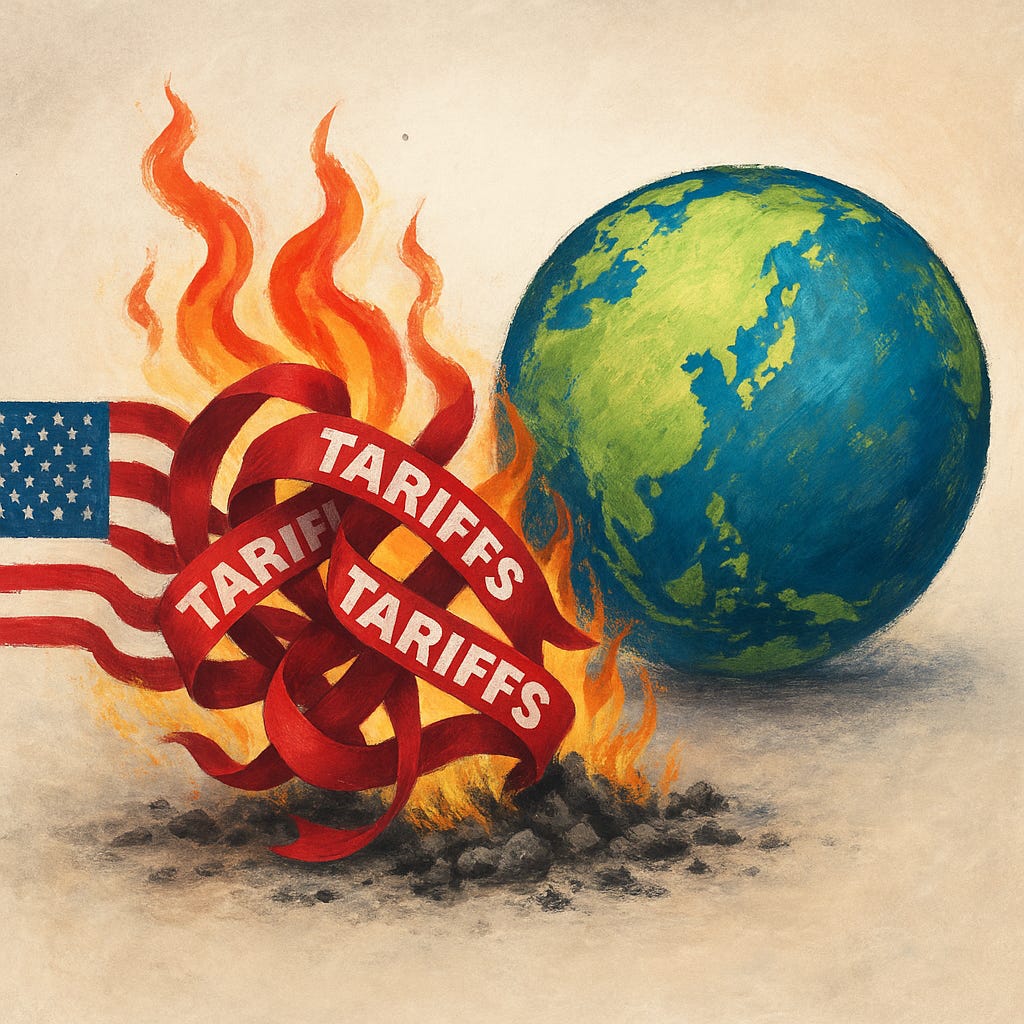
Wait a minute, some of you may be saying. Over? How can it be over when Trump just announced a sweeping new set of tariffs, including a 40% global duty on “transshipments” meant to evade specific country tariff rates (as in when China sends stuff to, let’s say Turkey, so that Turkey can send stuff to the United States at lower rates). But it is over, in that the bullets have been shot, the missiles fired, and the omnipresence of uncertainty is now being integrated as a feature, not a bug, and hence uncertainty has become…its own form of certainty.
So, who won? The short answer is no one. Everyone lost, though because the rates were much less than feared in early April, the dire short-term economic consequences were avoided. Or to put it in the active tense, Trump avoided the worst by delaying and then reducing the rates. Several countries agreed to trade “deals,” all of which were essentially press releases and bound countries such as South Korea and the United Kingdom to purchase a certain amount of American goods and invest in the U.S., but with no clarity as to whether those commitments were over and above what was already in place. And of course, touting deals as an outcome of tariffs is like starting a fire, putting it out after moderate damage, and then claiming to be a brilliant firefighter.
Make no mistake. The trade war is over only in the sense that the contours of the new regime are clear and there is no longer any mystery about how this American presidential administration will conduct trade policy. It is over also in the sense that there are no more surprises left, and governments and markets have now adjusted to the chaos machine that is the Trump administration when it comes to trade. It is also over in that there is a new normal of higher trade barriers in the United States to foreign goods, though it remains to be seen by how much given that there is a very high likelihood that the U.S Appeals Court for the Federal Circuit and then the Supreme Court will find that Trump has exceeded his constitutional authority in his frequent and sweeping tariff declarations.
The fact that the war is over is a good thing. The fact that it happened at all, for no good economic or national security reasons; the fact that the American president is asserting a questionable right to unilaterally set trade rates without Congress and at whatever rate he deems; the fact that the Trump administration has been inept and erratic in its demands and is seen more as mercurial and vindictive than strategic – none of these are good things, nor are the long-term economic implications should tariffs remain. Much of the short-term damage was caused by the on-again, off-again, follow-the-bouncing-ball approach to rates (as well as proposed rates on China of 145%, which never went into place but would have been a de facto trade embargo). Those harms are now done.
Like much of Trumplandia, the headlines belie a more complicated and more nuanced reality. On August 1, for instance, Trump announced 35% import duties on Canadian goods, which is about as severe as could have been expected. That was touted by the White House as a staunch response to unfair trade practices and fentanyl creeping across the U.S.-Canadian border. But goods compliant with the USMCA agreement (the renegotiated NAFTA that Trump agreed to 2018) will not be subject to those duties, and that includes car parts and in fact most of Canada’s $450 billion in exports to the United States. The result is that realized duties on Canadian goods will be slightly above 5%, if the courts do not strike them down entirely. Similar exemptions lower the actual aggregate rate on imports from the European Union and many other countries.
Even so, the current set of global trade duties being applied by the administration – if they remain in place – would be about 18%. Until the beginning of the year, that was 2.4%. As Jason Furman pointed out, these are rates higher than at any point since the 1930s, but they have not had the dire economic consequences that economists feared in April. There are at least two reasons for that: one is that the actual rates are significantly lower than the April scenarios; the other is that because the rates are lower and have reams of exceptions, the effect will be digested slowly rather than suddenly. That makes a substantial difference in how countries, companies, and consumers adjust. A gradual increase in prices at the wholesale and retail level is incomparably easier to adapt to than a spike.
Let’s say, however, that U.S. rates end up at about 15% for the $4 trillion of U.S. imports. That is a $600 billion tax on companies and/or consumers, depending on how those costs are passed along and to whom. And it almost certainly won’t be that much, as some imports will be substituted with domestic goods, and some consumers will cut back on spending. A few hundred billion extra dollars will certainly help reduce annual government deficits, but the level of tariffs will not be nearly enough to force companies to reshore manufacturing on U.S. soil. Most of the goods the United States imports it either cannot make or grow domestically (mass quantities of avocados, for instance) or cannot make cheaply enough (iPhones). A 15% tax is just high enough to reduce a company’s profitability or to generate persistent inflation.

The challenge in criticizing the Trump tariff war is that the economic effects, pro or con, will take a long while to manifest, and it will not always be clear what effect they are having. If U.S. GDP growth is half to a full percent lower next year than it would have been without the tariffs, it will still be an uphill battle for opponents to prove that lower economic growth is directly attributable to higher trade barriers. On the flip side, the benefits – if there are any – will also take time to make their way into the American economy.
At the same time, countries around the world have taken the tariff war as a disturbing wake-up call that they should diversify their trade and their economies to be less dependent on the United States. That will ultimately benefit them and the global economy, but it will slowly erode the centrality of the United States and the sheer volume of trade with it.
Much as the effects of Brexit on the United Kingdom have unfolded over years and never been crystal clear even as they have been undeniable, the impact of the trade war will take time to work its way through the U.S. and global economies. At current levels, the tariffs are just high enough to be a tax, a spur to inflation of some goods and headwind for economic growth and not high enough to create systemic change that many in the Trump administration claim to want.
Should the courts invalidate the legal justification for most of these tariffs, the Trump team will likely find other statutes, but none will afford the sweeping imposition of permanent tariffs at the scale Trump craves. That will lead to another bout of intense uncertainty, except this time with the potential for lower tariffs and fewer negative effects. Markets may well rally on that news, as it would not only signal the formal end to this trade war but would also make explicit the guardrails that will preclude another.
This trade war has been unnecessary and ineffective at doing much other than disrupting global trade. But now at least it’s over. Its effect will be lasting, or at least for a few years (whichever comes first), but the first step when digging a grave for yourself is…stop digging. Trump hasn’t stopped and never will, but at least this trade war is grinding to a halt.
Thank you for your thoughts on these matters. There does not seem to have been an understandable economic reason for these attempts other than 'they're screwing us' (which in trumpspeak means him, somehow). that's a terrible way to implement policy
Well put. It’s easy to imagine this era someday appearing in textbooks under a chapter titled “History’s Greatest Unforced Errors.”