
What Did I Miss?
Panic is not a strategy, either.

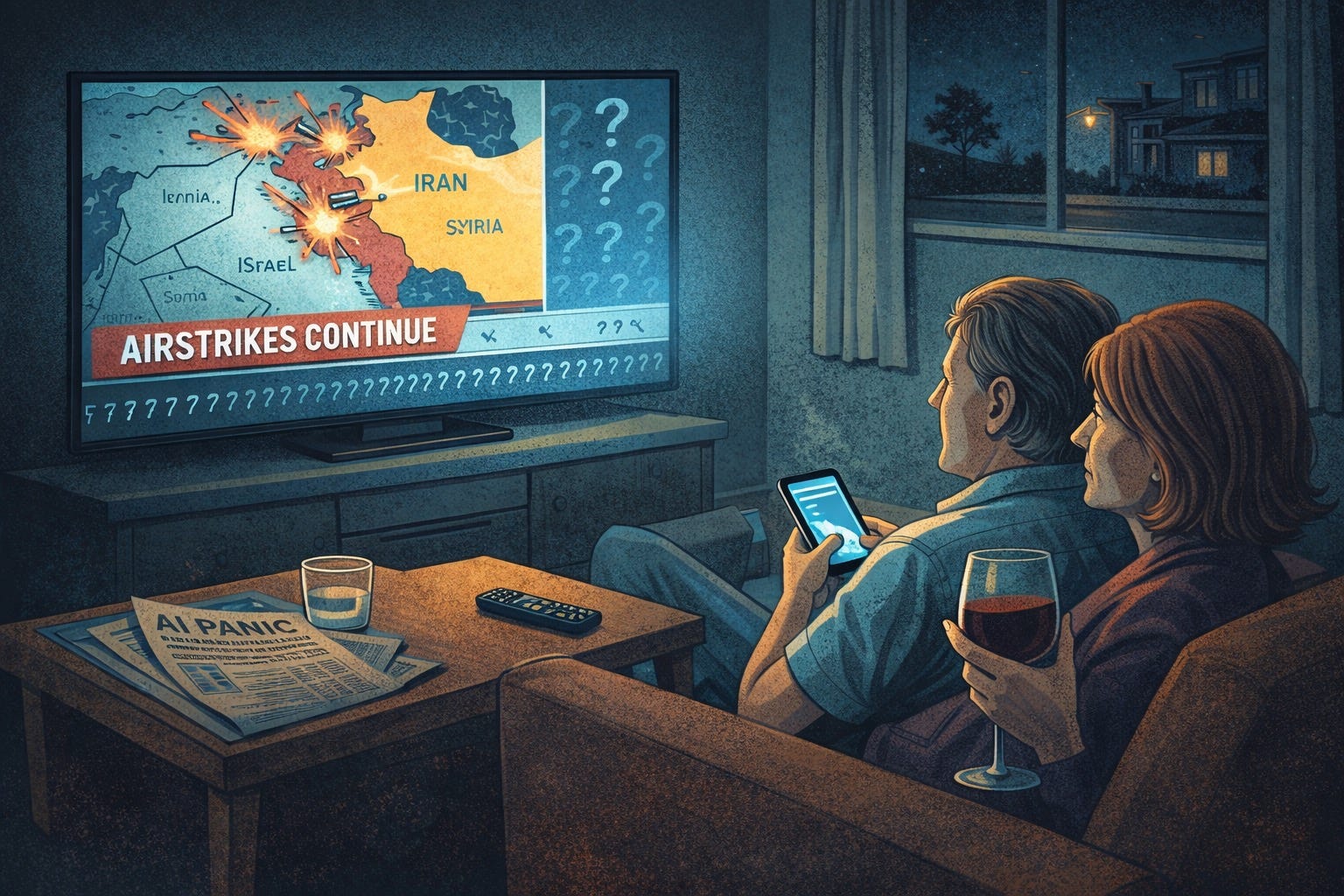
I’m told there’s a lot going on in the world just now. A few weeks ago, I wrote a piece for The Washington Post about the investor panic over AI that was roiling stock markets and sending shares of software companies especially into a tailspin. I argued that freak-outs over the ramifications of new technology are nothing new, even if AI is very new and even if it remains utterly unclear if we are headed for utopia, Armageddon, or some weird composite.
I also suggested that panic as a guide to action rarely turns out well, and that the people most afraid at the moment are the experts, because they are the ones most aware of the nightmare possibilities. Think of the nuclear scientists circa 1945 who understood that they had unleashed not just the atom but the potential for humans to destroy the world. Hence Oppenheimer quoting from the Bhagavad Gita: “I am become Death, the Destroyer of worlds.” Hence as well the counter-terrorism experts post 9/11 who were sure more catastrophic attacks were to follow, and the hand-wringing scientists at Covid’s origin in the spring of 2020. All their fears of what was possible were legitimate, but what those most deeply in the trenches tend to lose sight of is the line between what is possible and what is probable.
That’s the rub, and it’s no different for AI: All the fears are possible, but that doesn’t mean they are likely. With any emergent transformative technology, we simply have no way to calibrate odds and probabilities, so we more often than not default to gaming out worst-case scenarios. There’s some strength in that, if it helps us prepare for contingencies. But today, it too often results in a panic that freezes rather than an awareness that inspires.
That WaPo piece, which you can find here, was published … the day before the U.S. and Israel began bombing Iran. It was, as you might imagine, overtaken by events. Not that those AI-related issues are about to be altered by what’s happening overseas.
And much like AI, none of us knows how this “warlette” ends. Two things do seem certain, however: 1. There is moderate American domestic support (albeit tepid in comparison with other conflicts) for this video-game combat in which a few soldiers will lose their lives, as long as that is the cost of a supposedly safer world; and 2. There is almost no domestic appetite for the U.S. Army and Marines invading Iran and remaining there with the attendant loss of life and open-ended presence. Special Forces, in and out, à la Caracas, sure. But for anything beyond that — barring a major attack on U.S. soil directly linked to the Iranian government — there is no buy-in. Nor are Americans prepared to sacrifice economically, for any extended period, to topple the mullahcracy.
All of which means the Trump administration is fighting a war with a ticking clock, rather than with the latitude it actually needs to accomplish its aims of defanging the regime. Could it still turn out okay, with a changed, denuclearized Iran? Anything is possible, but the lack of communication, lack of preparation for the closure of the Strait of Hormuz, and lack of a clear path to a viable endgame does not inspire confidence. Hope, it has been said again and again, is not a strategy. Still, let’s say it one more time: Hope is not a strategy.
I recognize that this is not an optimistic assessment of the first two weeks of this fighting. Optimism, for me, does not mean chronically humming Monty Python’s “Always Look on the Bright Side of Life.” (Hence, the “Edgy” in my alias.) And given how fast the world moves, this warlette may be winding down by the time you read this; it certainly can’t go on much longer as is. Either Israeli commandos will seize the remaining nuclear material in Iran, the Iranian regime will crack, or oil shocks and transportation disruptions will put too much pressure on Trump. And after some or all of this unfolds over the next weeks, not months, we can figure out what the hell just happened and what it means for the future.